Showing posts with label cat. Show all posts

Wednesday, May 13, 2020

Feline and Canine Body Language


The process of grooming a dog is so much more involved than many people realize. Not only are we bathing, drying, cutting hair, and trimming nails to make pets sparkle, groomers are constantly watching for subtle body language signals from pets.


Every cat and dog give signals to how they are feeling about certain things. While we all know that a hissing cat is an unhappy or scared cat, did you know that a cat who is blinking their eyes slowly is a cat who trusts you? They feel safe in your presence. A cat who falls asleep on the couch beside you trusts you. A cat who falls asleep in your lap really trusts you. A cat who falls asleep in your lap and begins to dream trusts you with their very life! Head boops are a sign of deep affection. When a cat rubs their cheeks against you, they are claiming you as theirs.

While groomers will generally only see the alert, upset, and sometimes downright angry side of a cat, dogs show a much wider range of emotion during their visits. Groomers are constantly on watch for signs that a dog is becoming stressed. Things like turning their heads away, sideways glances, big yawns, and lip licking are all signs that a dog might be feeling a little too stressed out by their grooming. A stressed dog might try to sniff the table while turning away in an attempt to tell the groomer that they want to retreat in peace. Unfortunately, we can’t always allow the groom to end at that moment so it is up to the groomer to recognize these signals and change the dog’s mind! Something as simple as a scratch behind the ears and some kind words can make all the difference!

Groomers want to see a happy, relaxed dog. This is a dog who has
an overall “soft” appearance. They don’t appear tense or nervous. Their movements are wiggly. They might flop a little when moved around. Their tails might wag at a steady rate. If they are panting, their lips are loose and not tight against their teeth. They might suddenly burst into a wiggly play bow as the groomer walks around the table. The ultimate goal of any groomer is to convince every dog they see that this is how grooming should be!

Many dogs are not so sure though. They might show signs of being stressed or simply just nervous. They might be tense, shifting their weight from paw to paw. They might keep one paw slightly raised. Their ears might either be constantly moving or pinned back against their heads. A groomer needs to know the dogs they work so they remember if this is normal for the dog or not. During times of high stress such as around the holiday seasons, even the most mellow, relaxed dog might become more tense for their grooming sessions simply due to all the changes around them.

At times, groomers might use their own body language to “talk” to the dogs in a way the dogs are more likely to understand. They might half blink or do a small yawn to show they are relaxed. They might drop their shoulders and turn slightly to the side to be non-threatening. Or, if a dog is starting to act up, a groomer might stand taller and more square to show they are not going to put up with foolishness. A particularly rambunctious dog might even receive a hard, direct stare to show the groomer means business. As soon as the dog settles and looks away, the groomer will then relax, yawn a little, and continue on. Quite often “talking” to the dogs in their own language produces better results than trying to coo and calm them with human language!

“Talking” to dogs with their own body language goes beyond the grooming salon as well! If your dog is nervous around certain things such as blowing plastic bags while on a walk, putting on an aura of calm by being relaxed and yawning a little, can help to put your dog at ease! If it doesn’t bother you, maybe it isn’t so scary after all! You can even “talk” to your cat by slowly blinking at them or rubbing your cheek against theirs when they come to you for attention!

Wednesday, April 15, 2020

Infestation Prevention

Spring has finally arrived! We think anyway. We are definitely somewhere between winter and summer. Sometimes it seems like we have all three seasons in one 24 hour period! Even though us humans are all stuck inside our homes, outside, the flea and tick populations are exploding! This time of the year, it is not uncommon for groomers to see a vast increase in the number of dogs needing baths due to flea infestations. Unfortunately, this year, we are not available to help at the start of the season!

Prevention is more important than ever this year. If you are one of the many people who only treat their dog with preventatives during the warmer months, it is time to start! Even if you planned to start next month or even the month after, start now. Vet offices and pet stores can still take orders for flea collars, chews, or drops. As Benjamin Franklin once said, “An ounce of prevention is worth a pound of cure.”

While we cannot currently take our dogs to the dog park or even out to the city parks, fleas and ticks can abound everywhere. Squirrels, deer, fox, raccoon, and coyotes can all live in suburban and urban areas. Wildlife quite often carry fleas and ticks. If a deer has crossed the road just before you walk your dog through the area, there is a chance that they could have dropped fleas. Those fleas could then jump onto the next living thing that passes by: you and your dog!

It only takes a single flea to start an infestation in your home. You will likely never see the first one too. By the time you start to see actual, live fleas, your home and your pets are already infested. Once your home in infested, it can be an extremely long and difficult process to completely eliminate all the fleas. No one wants strangers coming into their homes right now. However, complete eradication of a flea problem will often require the services of an exterminator.

Ticks are harder to get rid of since they tend to live in long grasses, brush, and on certain types of trees. While they are not likely to cause an infestation like fleas do, they can still carry some pretty serious diseases. With veterinarian offices also on lock down procedures, it might take a while for them to see a dog suffering from a tick borne illness. So the best thing to do is to get all of your pets on a reliable preventative! Also, keep up with your yard work, especially if your home backs up to an open field or a wooded area. By keeping the grass in the areas your dog frequents short, it is much less likely that ticks will be present. Try to keep your pet out of longer grasses, weeds, and dense brush as well. If you do suspect your pet has been bitten by an infected tick, be sure to call your vet right away so you can get into to see them as soon as possible. For many tick borne illnesses, the faster your pet receives treatment, the less likely they are to suffer from life-long complications!

Not sure what preventative is the best to use in your area? Give your vet a call or send them an email! Even though they are busy sanitizing their offices multiple times a day, they will still be happy to offer suggestions of what products to use and where to get them!

Wednesday, April 8, 2020

PIck-up and Communication: A Reminder

As spring gets into full swing, grooming salons become a busy place! The increase of muddy yards means a lot of dogs need frequent baths. Dogs who are left a little longer for the winter will start to come in for those short spring hair cuts.  As soon as the stay-at-home orders lift, everyone will want to get their pets in for a good clean up! Groomers might be stretched a little thinner than normal trying to accommodate owners and pets alike.

Since we run a very small salon, we have a very limited space to hold onto pets after their grooming has been completed. We just wanted to take a brief moment to remind you that we ask you to be here within one hour of receiving the call letting you know your pet is ready to go home. Our day is a tight dance. We are counting on Fluffy going home so we can clean her kennel and use it for Bob who is expected to arrive shortly after Fluffy leaves. If Fluffy is still here when Bob arrives, we might not have a place for Bob to hang out!

If you know you might be a little late picking Fluffy up, just let us know! Let us know when you make the appointment so we can have an extra kennel available just in case. We do have crates at our homes for our own dogs we are happy to bring in if needed. If something comes up after you have made your appointment, give us a call or shoot us a text message to let us know. We will do our best to accommodate or we will let you know if it would be best to reschedule for another day.

The same goes for dropping off early. We ask that you arrive no more than 10 minutes early for your appointment so we have time to check Fluffy out and clean her kennel. If Bob arrives too early, we might not quite be ready for him! Again, communicate your needs and we will let you know how we can best accommodate them!

We understand things come up. You might not know until the day of your appointment that you need to drop off early or pick up a little later. Just let us know a soon as you can so we can figure something out! Communicating also eliminates the worry factor as well. We do genuinely worry about our clients when they do not show up on time! Was there an accident? Is there a traffic jam? Did someone suddenly become ill? Did the doctor appointment not go well and someone now has to be rushed to St. Louis for specific testing with a specialist? Your groomers are definitely two “Worst Case Scenario” worriers! Let us know what is going on so we don’t stress your pup out!

We anticipate being busier than usual once we are able to reopen.  If you can, please schedule your pet's grooming appointment on a day and at a time where you are not likely to be busy during their service.  This way, you can be ready to come get them as soon as we call.  It is looking like we will be completely booked for at least a few weeks when this is all over.  Help us keep things running extra smoothly so everyone can get the services they need as quickly as possible! Thanks! 

Wednesday, April 1, 2020

The Grooming Process: What People Think vs Reality

Have you ever wondered what, exactly, it takes to get a dog groomed? Or a cat? It must be such a fun thing to do! Playing with puppies and kittens all day long must be so easy!

The reality is that grooming is an extremely taxing process. Many groomers end up suffering from joint problems, specifically in the knee, hip, and lower back areas due to the long hours bending, twisting, lifting, and standing. Carpal Tunnel and Tennis Elbow are almost a guarantee from the repetitive motions. “Groomer’s Lung” can develop over time, leading to lung infections, chronic bronchitis, and difficulty breathing. It is caused by breathing in the dust, dirt, chemicals, and debris associated with grooming.

At any time, numerous injuries can occur such as bites, scratches, bruises, cuts, sprains, strains, and falls. Plenty of groomers have had their careers ended by accidents. It is far, far more common for the groomer to become injured than the pets! Some of these injuries can be caused by the pets the groomer is working with. Others can be caused by the environment. Still others can be caused by just a moment of inattention. Just about every groomer out there has cut their own fingers and hands with their shears! Many will laugh as they show you the scars and tell you the story!

Compassion fatigue is another huge, potentially deadly, problem in the industry. Most groomers care so deeply for the pets they are trusted with that seeing pelted, once-a-year grooms, dogs with poor skin and over grown nails, and cats so matted they cannot move begins to take a mental toll. Owners who do not properly care for their pets, make impossible demands, and then berate a groomer for doing what is necessary to keep the pet happy and comfortable can make groomers feel like they are worthless. They can’t do anything right. Depression and hopelessness can begin to set in. Compassion fatigue is a problem across the entire animal industry and beyond. Each year, many professionals take their own lives as a result.

So what actually happens in the salon? What makes it so demanding? For a normal, regularly scheduled maintenance groom, the process can seem daunting with all the brushing, clipping, bathing, and drying. For a pet that is not on a regular schedule, it can be even more challenging!

The typical groom will start one of two ways. After we give your pet a quick evaluation, we will either clip their nails or head straight to the bath tub. Long nails must be clipped prior to the bath as they could pose a safety issue, potentially getting caught on kennel grates or doors. If your pet’s nails are in good shape, the bath is started immediately.

A bath is a lot more than just soap and water! Very often, a dog will be washed two, possibly even three times. The first wash with a basic shampoo will remove the bulk of the dirt and grime. Their anal glands will be checked during this first shampoo and emptied if needed. Occasionally, if the pet is excessively dirty, they might get another shampooing with the basic formula but typically, we don’t need to. The second shampoo will either be another round of the basic shampoo or a specific formula picked for the needs of your pet. We might use Avacado for dry or itchy skin, hypoallergenic for pets who might be a little more sensitive, or whitening for those who’s coats could use a little extra help to shine. While the second shampoo is on the dog’s coat, they are often brushed with a rubber curry or a brushing glove to make sure they are clean down to their skin across every single inch of their body from the ears back. The shampoo is then rinsed completely from the dog’s coat and skin. But it doesn’t end there! Next, a high quality conditioner is applied to the dog. It is brushed in with the rubber curry or brushing glove. While it sits, the dog’s face will be washed with either a hypoallergenic or lightly scented face wash or a blueberry facial treatment. This face wash is then rinsed away. The conditioner is rinsed though we quite frequently do not rinse it away completely as a good conditioner is designed to keep a dog’s skin in tip-top shape.

The bathing process will usually take only around 15 to 20 minutes per dog. However, if a deshedding treatment is what they need, there are extra steps of brushing, combing, raking, and blowing that take place. A thorough deshedding process can take up to an hour to complete!

The drying process is the next step. The dogs are wiped down with super absorbent cooling towels. These wick a surprising amount of water out of the fur! So much so that we often don’t even need to use a regular towel afterwards! While in the tub, the high velocity dryer will be used to blow the bulk of the remaining water off the dog. Depending on the size of the dog, they will either be dried further in the tub or they may be moved to our drying table. How dry the dogs get at this point depends on how they feel about the drying process. Some dogs will not tolerate the high velocity dryer. It is pretty loud after all! We don’t blame them! A dog who tolerates the dryer will be dried until they are just a little damp. After this dryer, the damp pet will be placed in a kennel. Using either a kennel dryer or a regular fan, they will take a break while they continue to dry. We will then either work on another dog or take a brief break to fill out paperwork, return phone calls/text messages, or, if we are lucky, scarf down a little bit of lunch!

Dogs may receive another dry on the grooming table using our small, heated, Flying Pig dryer affectionately known as Dumbo. This little dryer is great for taking the last bit of dampness from a dog’s coat or for drying feet and faces. Some dogs will need this last dry, some won’t. Some dogs will need a sanitary shave which is generally done before brushing just in case there are any tangles in sensitive places. Paw pads will usually be shaved at this time if needed and the nails also trimmed and filed. After any prep-work, dogs will be brushed at this point. Longer hair is brushed with slicker brushes and medium and fine toothed combs. The dog is brushed from head to tail, paying special attention to legs, feet, ears, and tail. Small tangles are carefully worked out. Larger mats are brushed around and noted for removal. Shorter haired dogs might still get brushed with a slicker and comb but are more likely to be brushed with a rubber curry, deshedding rake, and a Sleek Ez to remove excess undercoat. No matter the hair length, this brush out process can take 15 minutes or longer. If a dog is getting a deshed treatment, this brush out can take even longer as we need to remove as much of the shedding hair as possible.

For bath dogs, this is pretty much where the process ends. They get to go hang out in their crates until their owners can come pick them up. For dogs getting a haircut, they are only halfway there!

Using clippers, blades of various lengths, comb attachments, and very sharp shears, fur is clipped down to the desired length. This is frequently the longest part of the process. The first pass over the dog’s body is to take off the bulk of the fur being cut. We don’t worry about getting perfect results on the first pass though it is nice when it happens! Using a brush or comb, the fur is fluffed up again for a second pass. This is a more careful clip intended to bring the coat almost to the final state. There will still be finish work to be done though. The fur is carefully combed and fluffed. Longer spots are trimmed down with shears. The tail is trimmed up. The feet are rounded off. The head and face are saved for last. Ears and faces are carefully combed. Cheeks are fluffed up. Fur is carefully clipped and trimmed to make the dog as cute as possible! All in all, the haircut can take up to an hour to complete. If the dog is at all fidgety or uncooperative, it can take even longer!

All in all, a groom can go as quickly as one hour for a very cooperative dog that doesn’t mind being bathed, dried, and groomed straight through or it could take three to four hours if the dog requires frequent breaks.

Cat grooms are a little different. Generally, a cat’s nails are clipped as soon as we take them out of their carriers. They get their brush and/or haircut before they get a bath simply because most cats do not like baths! Cats are immediately dried as much as possible with absorbing towels, regular towels, and our friend Dumbo. If they are resistant to the bath and dry, nothing is forced upon them. Cats can hang out in the kennels with a fan if they need to, however, we prefer to get them in and out as fast as we can. Cats are very prone to stress-induced illness. The longer they spend in the salon environment, the more dangerous it is for them. We try hard to have cats in, groomed, and out in two hours or less.

After repeating this process four, five, six, or more times per day, it becomes easy to see that grooming is not at all just playing with cute critters all day long! It is a very demanding job but it is one that we would not trade for anything!

Wednesday, March 18, 2020

All Dogs Need Grooming


When we think of dog grooming, we tend to think of show dogs with their beautiful, flowing fur or their perky poms and top knots. Poodles and Shih Tzus immediately pop into most peoples’ heads as examples of grooms. Scruffy terriers with their carefully hand stripped coats might join the mix. And who can forget a perfect Schnauzer cut too?

Grooming goes far beyond styles for the show ring. It even goes beyond hair cuts in general. All dogs need to be groomed. Even short haired and hairless dogs will benefit from a bath, brush, and deshed treatment. Why? It is pretty simple!

Just like humans, dogs shed their skin cells in a 21 day cycle. The new cells form under the skin and mature over this period of time. Once they reach the surface, they hang around for a while before dying and shedding off, revealing healthy new cells underneath. The process happens in a never ending cycle starting the day they are born. It happens with humans too! Unlike humans, the skin surface for a dog is under a layer of fur. This can prevent those old cells from sloughing off in a timely manner. Dogs may develop itchy dandruff, flaky patches, yeast infections, or a host of other problems if they are not able to shed this skin.

Shedding hair can become a problem for even shorter haired pets. All dogs shed. Even so called “non-shedding” breeds like poodles and bichons shed. They simply shed less since their hair has a much longer growth cycle. Their kinky fur also tends to hold that shed fur in, potentially creating mats if it is not brushed out on a regular basis. Any dog with hair longer than an inch or two in length is at danger of developing mats. The longer the hair, the more easily it tangles. But even shorter haired dogs can have shedding problems. Their shed fur can impact into their coat, creating a thick, tight, hard to remove layer of fur and dander.

The good news is that grooming helps to solve both the problems of proper skin overturn and shedding! A proper bath with quality, pet specific shampoos and conditioners along with a good blow and brush out will help all the excess skin cells blow away. The shedding hair will come out as well, preventing any mats or impacting. You pet’s coat will be softer, shinier, and brighter after a bath. They will feel amazing too! Regular appointments will help to keep their nails in tip top shape as well!

Even hairless dogs and cats will benefit from a good scrub. They might not have as much hair to shed, but their skin is still prone to build-ups. They can develop black heads and zits. A moisturizing bath and an exfoliating scrub can greatly reduce the problems!

Help even your short haired buddies feel their absolute best by getting them on a regular grooming schedule. They will absolutely adore all the attention they receive in the salon and at home afterwards too!

Wednesday, March 11, 2020

Continued Education: Why Is It Important?


We all know our doctors, nurses, firefighters, police officers, and even veterinarians do continued education courses every year. We have all heard about trade shows for everything from the automotive industry to all things home and garden and even science and technology. Did you know there are trade shows and continued education courses for groomers and other pet professionals as well?

Its true! Trade shows and classes happen all across the country all year long. There are single day, specialized classes hosted by groomers and salons that cover very specific topics such as how to groom a specific breed or how to achieve perfect faces. There are small, 2 day, home town type shows as well as huge, week long expos! There are grooming competitions for all breeds and breed groups. There are creative grooming competitions as well where groomers show off their dying and scissoring skills. There are classes taught by the captains of the industry on everything from breed standards to breed cuts to techniques for using clipper combs to hand scissoring to handling cats and even information on skin and coat health. There are certification courses for things like safety and sanitation and first aid. The trade floors hold more products than you could ever ask for! New shampoos and conditioners, the latest and most updated equipment, bows and bandannas, scissors and brushes, grooming wear like smocks, pants, and aprons, and even things like leashes, collars, and toys for the awesome pups in your life! There are often folks who sharpen blades and shears as well as folks who can give you all the information you ever wanted about nail grinding accessories and electric tables. A day or week at a good expo can be a groomer’s dream come true. Yours truly dreams of going to Super Zoo in Las Vegas some day!

It isn’t all fun and games though. Mostly it is, but there is a serious side to these expos too. Those classes I mentioned before can be vital for groomers of all skill levels. Even the most seasoned groomer can learn a thing or two by attending seminars.

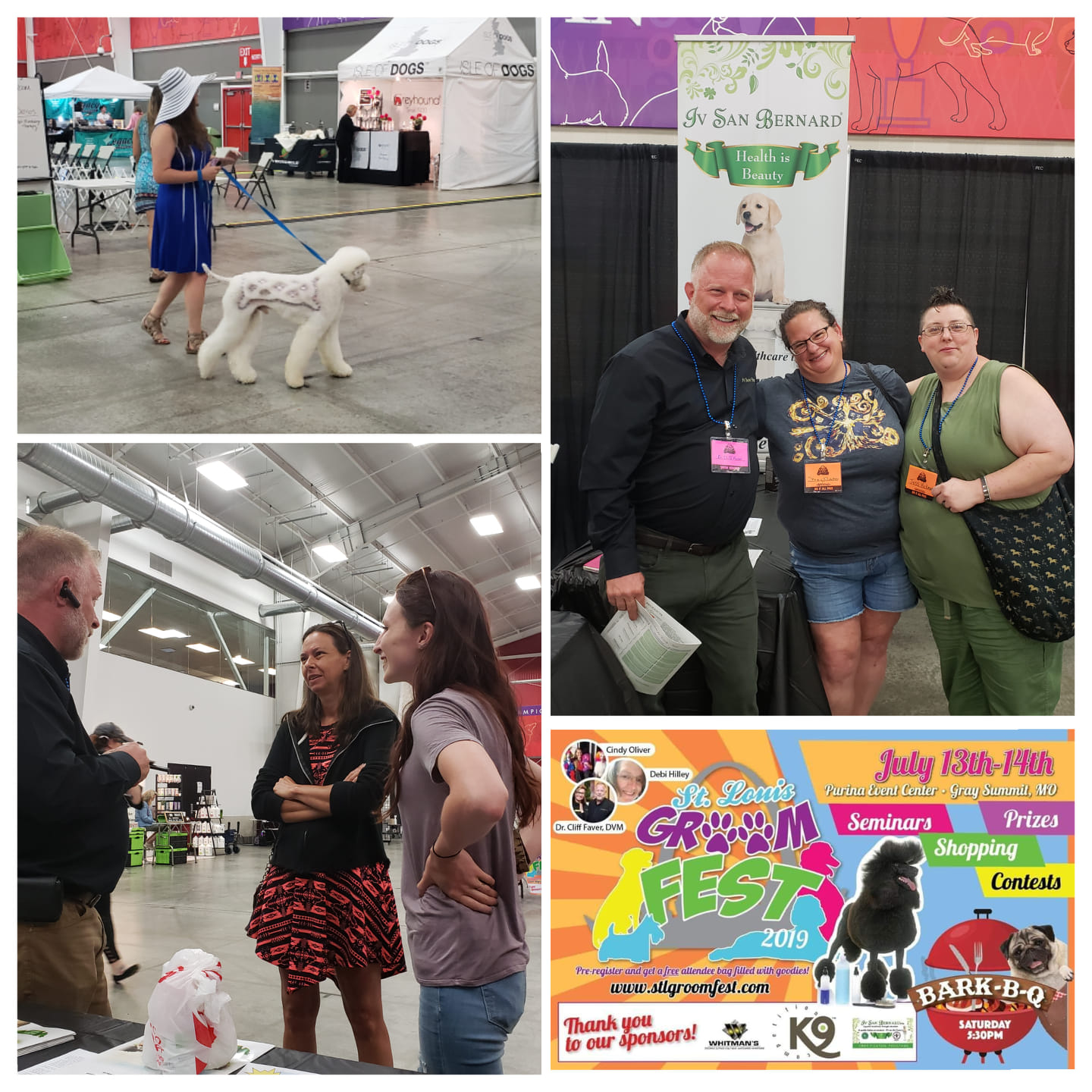
Each year, we attend a grooming expo in the St. Louis area. We spend our time at the show in order to gain new knowledge we then use to help your pets have the best grooming experience they possibly can! Even though we have spent almost a combined 25 years in the pet industry, Stacey and I admit that we do not know everything there is to know. While we have diverse backgrounds and training, there are still “holes” in our knowledge. Attending these trade shows is one of the best ways to “fill in the blanks” as it were.

We have taken classes on things such as Asian Fusion grooming to learn how to make those adorable round, teddy-bear looking faces. We have taken classes on using clip-on combs to achieve a natural looking hair cut. We have gained tips and tricks for making poodle top knots absolutely perfect. We have learned how other salons operate and taken some of what they do to make our salon what it is today. We have gained new knowledge about the cycle of skin growth, how shampoos and conditioners affect a dog’s skin, and even how to keep our salon as safe and sanitary as possible. Every year, we look forward to the new knowledge we will gain so we can pass it along in what we do!

We understand that it can feel a little frustrating when you try to make an appointment somewhere only to find out the business will be closed for a few days. However, when we close for trade shows, please remember that we are going so we can provide the very best for your pets!

Trade shows aren’t the only places we learn though. In this day and age, everything you ever wanted to know about anything at all is available with just a few clicks of a mouse. YouTube is a great source for learning, though you do have to take any information gained with a small grain of salt since there is no way to really know a person’s actual qualifications and background. Even keeping this in mine, there are innumerable videos on tips, tricks, and techniques on everything from how to shave a reluctant poodle’s feet to how to achieve a perfectly layered yorkie style head in under 10 minutes. There are product reviews to watch. There are handling tips. There are just plain fun grooming videos of happy dogs and happy groomers!

Books and magazines play a role in a groomer’s continued education as well although these tools might contain out of date information almost as soon as they hit the shelves. The world moves so fast now that print can hardly keep up! However, printed books about breed standards and proper breed cuts will always have a place on a groomer’s book shelf. Many magazines will contain more product and tool reviews that can be referenced later on. Some will even have step-by-step guides for certain cuts or techniques that can be handy to have nearby!

We will never consider our education to be complete. There will always, always, always be new things to learn, new places to learn them, and wonderful new people to learn from. As we learn new things, we will be sure to bring them home to our little salon in order to create the best grooming experience possible for your furry friends!

Wednesday, February 19, 2020

No Sedated Dogs!

We have all heard of That Dog. The one that maybe lives next door and never has a very pretty hair cut. The one that gets way too long before being shaved way down. The one that screams bloody murder for being brushed. The one that turns into Cujo when it’s nails or feet are touched. That dog that has been kicked out of every salon in the area and now must go to their vet twice a year for a fully sedated groom. We might have thoughts like “Well the groomer clearly didn’t try hard enough,” “All dogs can be trained!,” or “You just need to find the right groomer!”

The truth is that by the time a dog is to the point of a sedated groom, the groomers have tried many, many, many times. They have tried different times, different techniques, different frequencies for grooming. They have tried using different tools. They have tried getting assistance. They have tried grooming when there are no other dogs in the salon. They have tried having their coworker groom the dog since sometimes dogs and people just don’t click for many reasons. If they are a good groomer, they have likely tired more things than you can think of trying to gain this dog’s trust and find that one magical key to getting them groomed. And while most dogs can indeed be retrained for grooming with time and patience, many will also need a little extra medical help in order to get there. That is where sedation comes in.

“Sedation” can be anything from a mood altering medication like Prozac to help lessen anxiety to Trazadone which, while it is an antidepressant, has the benefit of making dogs sleepy, to Acepromazine which can tranquilize an animal for 6-8 hours. Sedation can even include full anesthesia at the veterinarian’s office. It all depends on the dog. A dog who is just scared might benefit from the Prozac or Trazadone. A dog who is full on aggressive might need the Acepromazine or full anesthesia.

At TLC Pet Services, we have decided that we will not groom any dogs who take any prescribed medications for the sole purpose of grooming. If your dog takes Prozac on a daily basis for general anxiety, that is acceptable since you are likely to already know any possible side affects and can let us know about them. If your dog takes Tramadol for pain and they end up sleepy, we don’t want you to not give it, but we might ask you to ask your vet about changing the dose on a groom day to avoid the sleepies. Daily medications, even if they are or can be used for the purposes of altering moods and sedation, are okay as long as you let us know what they take, when they often take it, and any side affects you have noticed. We don’t want anyone skipping daily meds just to get groomed after all!

The reason we do not groom sedated dogs is safety. While many, many groomers out there will groom sedated dogs, the risks often far outweigh the benefits. Every dog reacts differently to drugs. Some dogs will seem sleepy and woozy but then snap and become extra violent, lashing out without giving any warning signs. They might loose any bite inhibition they have, resulting in worse injuries for the groomer or even for themselves. Some dogs will fight through the sedative, causing the unpredictable behaviors. They might suddenly start thrashing around, trying to escape from the grooming loops and table, resulting in injuries to themselves and their groomers. There are heavier sedatives out there that might be prescribed if others have not worked. These can cause the dog to be completely aware of what is going on but be unable to react to the stimuli. How scary would it be for you if you were terrified of a vacuum cleaner and someone then gave you a drug, waited for it to kick in, then started vacuuming around you? You are 100% aware of the noise and the sensation. You are still terrified. But, you can’t do anything about it. You are not likely to react well next time someone brings a vacuum near you while you aren’t sedated!

Without professionally trained staff and equipment to monitor even lightly sedated dogs, we will have no way of knowing if your dog is staggering on the table because the medication is working or if it is because they are experiencing a medical emergency. The signs of a heart attack, seizure, or breathing problem might be reduced or not even present because the sedative is masking them. By the time the signs are clear, it might be too late for your pet. Even if we are fortunate to see the signs early on, we still have to rush your dog from the salon, to our cars, and then to the nearest vet who can help us. It will take a minimum of 5 minutes to get to the vet. Those 5 minutes could mean the difference between a healthy recovery and one with complications or even the death of the pet.

Even if your pet does not experience a medical emergency under sedation (which is most likely to be the case), their behavior can be a challenge. A sedated dog is a wobbly dog. They sway and stagger. They might randomly fall over. They move unpredictably. It is much more likely that your dogs is going to step into our clippers or shears and receive an accidental nick or cut. They might end up with bumps and bruises from accidentally staggering toward the edge of the table and stepping off. It is much, much harder to achieve a decent groom on a head that is always lolling to one side or the other. It is also much, much more dangerous to groom a lolling head as an eye might suddenly be where the shears are supposed to be!

So what should you do if your pet needs sedation for a groom? Talk to your vet! Not every office will provide sedated grooming but they will likely know which offices in the area do. Depending on how bad the dog is for grooming, some vets will provide fully sedated shave downs even if they do not provide regular grooming services. They are not pretty grooms but they are functional!

We never want to reach a point where we have to dismiss your dog from our salon. It causes us as much distress as it causes you! However, if we ever tell you that you need to talk to your vet about a sedated groom, please remember that we have your pet’s best interest at heart. We want them to be safe and happy. We hope that with time, effort, and retraining, they can reach a point where they can come back to see us in the future!

Wednesday, February 5, 2020

(Hypothetically) There Has Been An Emergency! This Is What We Will Do For Your Pet!

You brought your pup to the groomer. You expect to get a call in a few hours telling you Prince is all ready to come home. Instead, you get the call no one wants to hear or even make: there has been an accident.

We strive to be the safest salon there can possibly be. We take great care and caution when working with your pets. After all, these are little living beings with their own thoughts, feelings, and moods. Bad days can happen to pets just as much as they can happen to people. We pay close attention to their moods and feelings so we can anticipate how the groom is going to go and if Prince needs a few extra breaks on any given day.

In the event of an emergency, there are certain steps we will take to ensure Prince gets the correct care. First of all, the injury will receive a fast assessment. Is anything bleeding? How severe is it? Is it a scratch on the surface in a sensitive area? Is it a small nick on a mole or wart? Was there already a scab we accidentally opened up? Or is it a fresh, deep cut? Is there any injury at all or has Prince simply collapsed? Is he having a seizure? Is he not breathing? What is wrong?

As with humans, there are some minor injuries that require only a band-aid and monitoring. A quicked nail hardly bothers most dogs and can easily be “fixed” with stypic powder AKA Quick Stop or even cornstarch or flour at home. A weeping wart is a skin issue that can open easily. Sometimes they soften and open in the bath tub. Sometimes they open just by the dog bumping them on something! These generally require no more than a quick cleaning and time to scab over before we continue grooming. (If you know of any bumps or warts on your pet, feel free to remind us of where they are and definitely let us know about any new ones you find so we can watch out for them!) Much like a weeping wart, a pre-existing scab can sometimes soften and fall off during the bath, leading to possible redness or even bleeding. Sometimes, a small scratch on a spot of dry skin or in a sensitive area can look horrible but in reality just needs a little time to settle down. We are not vets nor do we pretend to be! When it comes to minor lumps, bumps, dings, and pre-existing wounds, we will always advise you of what we found and let you know how we would proceed with our own pets. Should you feel that you want a vet’s opinion on the matter, we will be happy to help you with that as well. Remember, we will never, ever hide anything from you nor will we ever lie about it. If we caused a minor scratch on Prince’s belly because he zigged and we zagged while combing him, we will own up to it and let you know! If the wart above Prince’s eye started oozing in the tub again, just like it has done every other time he has been in, we will still let you know. If we found a bump with a small scab on his neck under his collar area during his blow out, we will let you know and even show it to you if we can find it again.

If the injury is something more serious, a cut caused by the shears or clippers, an accidental poke to the eye with a slicker brush, or even a quicked nail that will not stop bleeding, fast action is required. We will not hesitate to wrap a bleeding injury in a clean towel and whisk Prince away to a vet’s office. We keep a small travel carrier in the back atop our kennel bank. It is easily accessible in even the most dire emergency. Prince will be placed in the safety of the carrier before heading straight to one of our own personal vehicles. Larger dogs will be leashed to the seats in our vehicles to prevent any escapes. We have worked hard to build a relationship with several area veterinarians. These are vets we take our own pets to as well as local vets who have offered to help us whenever we need them.

We will do the same thing if Prince appears to be suffering for any medical condition. If he has collapsed and is not breathing, we will rush him to the vet as fast as we safely can. If he appears to be having a seizure that shows no signs of stopping, we will rush him to the vet as fast as we safely can. If he is having a hard time breathing, standing, if he appears to be “loopy” and out of it. Anything out of the ordinary, Prince will be rushed to the vet.

We will call you immediately using your primary contact, your secondary contact, and even your emergency contact numbers. In fact, as soon as one groomer is aware of the problem, the other will be calling first a vet to notify them of the situation and then you, the owners, will be called. We will leave a message at each number but we also will not stop trying to reach you until we either get you or we reach someone who knows where you are. We will stay at the vet with Prince until you arrive. If you or someone you know is unable to go to the vet to be with Prince, we will stay with him. If the vet says Prince needs to stay in their care for a little while until you can pick them up, we will update you and either wait for you at the vet’s office if you want us to or return to the salon knowing that Prince is in the best possible care. If you cannot get there and the vet says Prince is okay to go home, we will update you and bring him back to the salon with us.

Have you noticed the certificate on the wall by the door? Our owner, Stacey, is certified in pet first aid and CPR! Every two years, she completes a course and renews her certificate, making sure she is up to date with any new information out there so you can be confident that Prince is safe in her salon. This summer, Jess will also be earning her certificate! We feel that keeping up to date with this type of learning is, though not mandatory in the industry, essential for any and all personnel who work with and around animals. Should we ever hire another groomer or bather, they too will complete courses and earn their certificates if they do not already have one. By taking hands-on learning, you can be sure that we have practiced the skills needed in the event of an emergency.

How about the framed posters above our leash holders? Have you noticed those? Wonder what they are? These posters are basic first aid reminders. In the event of an emergency, these posters hold vital information on how to do certain things such as help a dog who is choking, the steps for CPR, how to make an emergency muzzle, and even how to recognize and stop various types of bleeding. While our CPR and first aid certification training covers these topics and more, Stacey feels that the reminders need to be there for everyone to see just in case. We all forget things sometimes, especially when we are stressed! These posters are small reminders about how to help the pets in our care should we ever need to.

Please know that even a minor incident like quicked nails can upset even the most battle hardened groomers! We never want anything bad to happen to any pet left in our care. Accidents make us feel like we are the worst groomers on the planet. They can make us question our entire career path. When I say we feel awful, it hardly describes the sinking, horrible feeling. If we have had to rush your pet to a vet for any type of an emergency, even one not caused by a groomer, we are likely to be crying and feeling just as low as we can possibly feel!

As always, if you ever have any questions about any of our emergency protocols, about who we would take your vet to in case of an emergency, or how we might handle a specific emergency, please do not hesitate to ask! We take great pride in what we do. We always want you to feel comfortable with us and our salon!

Wednesday, January 22, 2020

Humanity Before Vanity

“Humanity before vanity.” You have heard us say it. We 

tag it on Instagram. It is our profile picture on Facebook. But what 

does it mean?

Humanity before vanity means we will never harm a pet to please a

 human.

Humanity before vanity means we will never push a pet beyond

 their limits for the sake of looks.

Humanity before vanity means we will never compromise a pet’s

 health or happiness to achieve “perfection.”

Humanity before vanity means the welfare of the pet always comes

 before the wants and desires of their human owners. Period.

At TLC Pet Services, everything we do is for the welfare of your 

pets. We take a hard stance on issues such as dematting, timing, and

 perfection.

By definition, dematting is the removal of tangled or matted coat 

from a pet. Generally speaking, when most groomers talk about 

dematting, they are referring to the process of brushing an 

extensively matted coat. Many owners do not want their dogs 

shaved short. They want all those tangles brushed out. A little 

conditioner should loosen it all up, right? And the dog won’t care, 

because they are just a dog! Wrong.


Dematting a coat can cause both physical and psychological 

damage to a pet. Tight matts can literally take hours to brush out. 

Even with the utmost care, it is likely the dog will end up with at 

least a few spots of brush burn, an irritation caused by the brush 

scraping one spot on the skin too many times. Tight matts can hide 

problems such as bruising, wounds, and infections. The matts are 

painful enough. Brushing over them can cause even more pain! 

There is a high chance any infections can become worse and could 

spread. A dog who is subjected to this process for the sake of 

vanity is likely to start dreading their grooming sessions. They may 

start to become fearful of the process or aggressive as they now 

anticipate grooming with pain. Imagine having a huge snarl in your

 own hair. The hairdresser refuses to shave it out and instead forces 

you to spend an hour sitting in the chair, scolding you if you 

wiggle, while pulling at your scalp. Is the pulling intentional? No. 

But it will happen no matter what products are used. You would not

be very happy and you would not want to go back to that 

hairdresser again!


Apart from the potential damage to the skin, dematting also 

damages the dog’s coat. When the hair matts together, the 

microscopic scales on each hair is acting like velcro. They stick 

together tightly. Brushing rips these scales apart as the hairs are 

separated, causing them to further fray. Often the dematted coat 

will have a frizzy appearance due to the damage. No amount of 

conditioner will repair all of the damage. Even with extra products 

and attention, the previously matted hair will matt again. The new 

matts usually form faster and will likely be tighter than before.


The only safe and comfortable way to dematt a coat, and the only 

way TLC Pet Services will dematt a coat, is by using clippers to 

shave as close as necessary to get between the matting and the skin.

 While we may attempt to brush a small spot here and there IF the 

dog tolerates it, we will not dematt the entire pet in any other 

manner.


Many folks want their pets back in their homes as soon as possible. 

We absolutely understand that! However, another aspect of 

humanity before vanity is timing. In a society that is all rush, rush, 

rush, we sometimes forget that going slow can be better for 

everyone. Some pets can be groomed in an hour or two. Some pets 

respond better to a slower approach and appreciate breaks. These 

pets might take three hours or more. Could these pets be groomed 

faster? Sure. Will they cooperate, be happy, and keep their positive 

attitudes about grooming? Not likely. Since we want everyone to be

 happy, safe, and comfortable, if a pet requires extra breaks, the pet 

will get extra breaks.


Perfection is a big part of why we believe in humanity before 

vanity. We all want our dogs to strut out of the grooming salon 

looking show ready! We want them to sparkle. We want every 

single hair in place. We want them to be the very picture of 

perfection! But sometimes what we want and what the pet can 

handle are two different things. Young puppies, seniors, and cats 

quite often get what we refer to as a “comfort groom.” There are 

times where we sigh and say “Well. Close enough is good enough I 

guess.” Why? Because the pet just isn’t having it! Believe us, we 

want your dog to strut out looking exactly like you pictured and we 

want your cats to be fluffy perfection! Sometimes, it just isn’t 

possible. The grooming process can be scary for inexperienced 

youngsters and for seniors who are either going blind, deaf, or 

maybe a little senile. Rather than force them into a perfect groom, it

 is better for them psychologically to just do the best we can. A 

young pup is being taught that grooming is not scary. A senior 

needs to be handled with care as they might be starting to 

experience some arthritis pain during the process. Cats are...cats.

 You never know what even the most perfect cat is going to do from

 one grooming session to the next!


For these pets, and for any nervous or fearful pets, we will always 

take the comfort approach. If they have any matting, the matts will 

be removed first. The sani trim will be done. We will do our very 

best to complete the haircut to the owners specifications but if the 

pet can’t handle it, we will not force it. Again, we want grooming to

 be fun and safe, not scary!


We understand that not everyone agrees with our approach. We will

 make every effort to work with you and your pets however, we 

will always chose humanity over vanity!

Feline and Canine Body Language

The process of grooming a dog is so much more involved than many people realize. Not only are we bathing, drying, cutting hair, and...