Wednesday, February 19, 2020

No Sedated Dogs!

We have all heard of That Dog. The one that maybe lives next door and never has a very pretty hair cut. The one that gets way too long before being shaved way down. The one that screams bloody murder for being brushed. The one that turns into Cujo when it’s nails or feet are touched. That dog that has been kicked out of every salon in the area and now must go to their vet twice a year for a fully sedated groom. We might have thoughts like “Well the groomer clearly didn’t try hard enough,” “All dogs can be trained!,” or “You just need to find the right groomer!”

The truth is that by the time a dog is to the point of a sedated groom, the groomers have tried many, many, many times. They have tried different times, different techniques, different frequencies for grooming. They have tried using different tools. They have tried getting assistance. They have tried grooming when there are no other dogs in the salon. They have tried having their coworker groom the dog since sometimes dogs and people just don’t click for many reasons. If they are a good groomer, they have likely tired more things than you can think of trying to gain this dog’s trust and find that one magical key to getting them groomed. And while most dogs can indeed be retrained for grooming with time and patience, many will also need a little extra medical help in order to get there. That is where sedation comes in.

“Sedation” can be anything from a mood altering medication like Prozac to help lessen anxiety to Trazadone which, while it is an antidepressant, has the benefit of making dogs sleepy, to Acepromazine which can tranquilize an animal for 6-8 hours. Sedation can even include full anesthesia at the veterinarian’s office. It all depends on the dog. A dog who is just scared might benefit from the Prozac or Trazadone. A dog who is full on aggressive might need the Acepromazine or full anesthesia.

At TLC Pet Services, we have decided that we will not groom any dogs who take any prescribed medications for the sole purpose of grooming. If your dog takes Prozac on a daily basis for general anxiety, that is acceptable since you are likely to already know any possible side affects and can let us know about them. If your dog takes Tramadol for pain and they end up sleepy, we don’t want you to not give it, but we might ask you to ask your vet about changing the dose on a groom day to avoid the sleepies. Daily medications, even if they are or can be used for the purposes of altering moods and sedation, are okay as long as you let us know what they take, when they often take it, and any side affects you have noticed. We don’t want anyone skipping daily meds just to get groomed after all!

The reason we do not groom sedated dogs is safety. While many, many groomers out there will groom sedated dogs, the risks often far outweigh the benefits. Every dog reacts differently to drugs. Some dogs will seem sleepy and woozy but then snap and become extra violent, lashing out without giving any warning signs. They might loose any bite inhibition they have, resulting in worse injuries for the groomer or even for themselves. Some dogs will fight through the sedative, causing the unpredictable behaviors. They might suddenly start thrashing around, trying to escape from the grooming loops and table, resulting in injuries to themselves and their groomers. There are heavier sedatives out there that might be prescribed if others have not worked. These can cause the dog to be completely aware of what is going on but be unable to react to the stimuli. How scary would it be for you if you were terrified of a vacuum cleaner and someone then gave you a drug, waited for it to kick in, then started vacuuming around you? You are 100% aware of the noise and the sensation. You are still terrified. But, you can’t do anything about it. You are not likely to react well next time someone brings a vacuum near you while you aren’t sedated!

Without professionally trained staff and equipment to monitor even lightly sedated dogs, we will have no way of knowing if your dog is staggering on the table because the medication is working or if it is because they are experiencing a medical emergency. The signs of a heart attack, seizure, or breathing problem might be reduced or not even present because the sedative is masking them. By the time the signs are clear, it might be too late for your pet. Even if we are fortunate to see the signs early on, we still have to rush your dog from the salon, to our cars, and then to the nearest vet who can help us. It will take a minimum of 5 minutes to get to the vet. Those 5 minutes could mean the difference between a healthy recovery and one with complications or even the death of the pet.

Even if your pet does not experience a medical emergency under sedation (which is most likely to be the case), their behavior can be a challenge. A sedated dog is a wobbly dog. They sway and stagger. They might randomly fall over. They move unpredictably. It is much more likely that your dogs is going to step into our clippers or shears and receive an accidental nick or cut. They might end up with bumps and bruises from accidentally staggering toward the edge of the table and stepping off. It is much, much harder to achieve a decent groom on a head that is always lolling to one side or the other. It is also much, much more dangerous to groom a lolling head as an eye might suddenly be where the shears are supposed to be!

So what should you do if your pet needs sedation for a groom? Talk to your vet! Not every office will provide sedated grooming but they will likely know which offices in the area do. Depending on how bad the dog is for grooming, some vets will provide fully sedated shave downs even if they do not provide regular grooming services. They are not pretty grooms but they are functional!

We never want to reach a point where we have to dismiss your dog from our salon. It causes us as much distress as it causes you! However, if we ever tell you that you need to talk to your vet about a sedated groom, please remember that we have your pet’s best interest at heart. We want them to be safe and happy. We hope that with time, effort, and retraining, they can reach a point where they can come back to see us in the future!

Wednesday, February 5, 2020

(Hypothetically) There Has Been An Emergency! This Is What We Will Do For Your Pet!

You brought your pup to the groomer. You expect to get a call in a few hours telling you Prince is all ready to come home. Instead, you get the call no one wants to hear or even make: there has been an accident.

We strive to be the safest salon there can possibly be. We take great care and caution when working with your pets. After all, these are little living beings with their own thoughts, feelings, and moods. Bad days can happen to pets just as much as they can happen to people. We pay close attention to their moods and feelings so we can anticipate how the groom is going to go and if Prince needs a few extra breaks on any given day.

In the event of an emergency, there are certain steps we will take to ensure Prince gets the correct care. First of all, the injury will receive a fast assessment. Is anything bleeding? How severe is it? Is it a scratch on the surface in a sensitive area? Is it a small nick on a mole or wart? Was there already a scab we accidentally opened up? Or is it a fresh, deep cut? Is there any injury at all or has Prince simply collapsed? Is he having a seizure? Is he not breathing? What is wrong?

As with humans, there are some minor injuries that require only a band-aid and monitoring. A quicked nail hardly bothers most dogs and can easily be “fixed” with stypic powder AKA Quick Stop or even cornstarch or flour at home. A weeping wart is a skin issue that can open easily. Sometimes they soften and open in the bath tub. Sometimes they open just by the dog bumping them on something! These generally require no more than a quick cleaning and time to scab over before we continue grooming. (If you know of any bumps or warts on your pet, feel free to remind us of where they are and definitely let us know about any new ones you find so we can watch out for them!) Much like a weeping wart, a pre-existing scab can sometimes soften and fall off during the bath, leading to possible redness or even bleeding. Sometimes, a small scratch on a spot of dry skin or in a sensitive area can look horrible but in reality just needs a little time to settle down. We are not vets nor do we pretend to be! When it comes to minor lumps, bumps, dings, and pre-existing wounds, we will always advise you of what we found and let you know how we would proceed with our own pets. Should you feel that you want a vet’s opinion on the matter, we will be happy to help you with that as well. Remember, we will never, ever hide anything from you nor will we ever lie about it. If we caused a minor scratch on Prince’s belly because he zigged and we zagged while combing him, we will own up to it and let you know! If the wart above Prince’s eye started oozing in the tub again, just like it has done every other time he has been in, we will still let you know. If we found a bump with a small scab on his neck under his collar area during his blow out, we will let you know and even show it to you if we can find it again.

If the injury is something more serious, a cut caused by the shears or clippers, an accidental poke to the eye with a slicker brush, or even a quicked nail that will not stop bleeding, fast action is required. We will not hesitate to wrap a bleeding injury in a clean towel and whisk Prince away to a vet’s office. We keep a small travel carrier in the back atop our kennel bank. It is easily accessible in even the most dire emergency. Prince will be placed in the safety of the carrier before heading straight to one of our own personal vehicles. Larger dogs will be leashed to the seats in our vehicles to prevent any escapes. We have worked hard to build a relationship with several area veterinarians. These are vets we take our own pets to as well as local vets who have offered to help us whenever we need them.

We will do the same thing if Prince appears to be suffering for any medical condition. If he has collapsed and is not breathing, we will rush him to the vet as fast as we safely can. If he appears to be having a seizure that shows no signs of stopping, we will rush him to the vet as fast as we safely can. If he is having a hard time breathing, standing, if he appears to be “loopy” and out of it. Anything out of the ordinary, Prince will be rushed to the vet.

We will call you immediately using your primary contact, your secondary contact, and even your emergency contact numbers. In fact, as soon as one groomer is aware of the problem, the other will be calling first a vet to notify them of the situation and then you, the owners, will be called. We will leave a message at each number but we also will not stop trying to reach you until we either get you or we reach someone who knows where you are. We will stay at the vet with Prince until you arrive. If you or someone you know is unable to go to the vet to be with Prince, we will stay with him. If the vet says Prince needs to stay in their care for a little while until you can pick them up, we will update you and either wait for you at the vet’s office if you want us to or return to the salon knowing that Prince is in the best possible care. If you cannot get there and the vet says Prince is okay to go home, we will update you and bring him back to the salon with us.

Have you noticed the certificate on the wall by the door? Our owner, Stacey, is certified in pet first aid and CPR! Every two years, she completes a course and renews her certificate, making sure she is up to date with any new information out there so you can be confident that Prince is safe in her salon. This summer, Jess will also be earning her certificate! We feel that keeping up to date with this type of learning is, though not mandatory in the industry, essential for any and all personnel who work with and around animals. Should we ever hire another groomer or bather, they too will complete courses and earn their certificates if they do not already have one. By taking hands-on learning, you can be sure that we have practiced the skills needed in the event of an emergency.

How about the framed posters above our leash holders? Have you noticed those? Wonder what they are? These posters are basic first aid reminders. In the event of an emergency, these posters hold vital information on how to do certain things such as help a dog who is choking, the steps for CPR, how to make an emergency muzzle, and even how to recognize and stop various types of bleeding. While our CPR and first aid certification training covers these topics and more, Stacey feels that the reminders need to be there for everyone to see just in case. We all forget things sometimes, especially when we are stressed! These posters are small reminders about how to help the pets in our care should we ever need to.

Please know that even a minor incident like quicked nails can upset even the most battle hardened groomers! We never want anything bad to happen to any pet left in our care. Accidents make us feel like we are the worst groomers on the planet. They can make us question our entire career path. When I say we feel awful, it hardly describes the sinking, horrible feeling. If we have had to rush your pet to a vet for any type of an emergency, even one not caused by a groomer, we are likely to be crying and feeling just as low as we can possibly feel!

As always, if you ever have any questions about any of our emergency protocols, about who we would take your vet to in case of an emergency, or how we might handle a specific emergency, please do not hesitate to ask! We take great pride in what we do. We always want you to feel comfortable with us and our salon!

Saturday, February 1, 2020

Fleas and Ticks: Start Now To Avoid Infestations This Spring!


With spring on the way, it is time to start thinking more about fleas and ticks, especially if your pet is not on a preventative during the colder months.
Missouri’s wacky weather means it does not always get cold enough for long enough to really kill off any fleas and ticks that could be lurking in our yards. It is a good idea to keep your pet on some sort of preventative year round for this reason.
Even if your pet is on a preventative, the spring pest boom can mean that they still have a few problems. The very best way to prevent a full on infestation is to check your pet and your home constantly for unwanted visitors.
The fastest way to check your pet for fleas is to use a fine toothed flea comb. The teeth on these combs are spaced so closely that fleas and flea dirt cannot slip through them. The downfall is that if your pet has a very long or dense coat, you may not be able to get down to their skin but we will cover that in just a minute. Using the flea comb, make a single swipe from the base of your pet’s neck all the way down to the base of their tail. Upon looking at the comb, you will hopefully see nothing more than a few stray hairs. You may, however, see a live flea or two or just small, black specks. If you see a flea, talk to your vet immediately about the best ways to get rid of them. If you only see specks, you will have to do a little more detective work. Tap the specks onto a white paper towel. Add a few drops of water directly over the specks and wait. If nothing happens, these are probably just little flakes of dirt your pet has picked up by rolling around. I know mine love to roll in the dirt and often have me questioning! If the specks start to dissolve and turn a rusty reddish color, it is flea poop AKA flea dirt. This means there are fleas on your pet, even if you can’t find any with the comb.
For your longer and thicker haired pets, if you cannot get a comb down to their skin or through their coat, part the hair at the base of their tail. This is the most common place to find flea dirt. If you see those tell tale black specks, try to pick a few off and do the paper towel experiment. The belly is another common place to see live fleas. If you flip your pet on their back, you may catch a glimpse of a flea or two scuttling away to safety. You may also notice small red bumps where fleas have been biting them. These can be present anywhere on the pet but are easiest to see on the belly.
Sometimes, despite your best efforts to find something, you won’t and your pet will still be scratching at their necks or chewing on their legs and hind quarters. This might be a sign of fleas but it could also be a sign of a skin or joint problem. If you have any doubts at all, talk to your vet. 
Should your pet have fleas on them, it is almost guaranteed that you have fleas in your home. The life cycle of a flea goes through four stages: eggs, larva, pupa, and adult. While most products will kill larval and adult fleas, the eggs and pupae can be harder to eliminate. This can cause a vicious cycle where you have treated your pets and your home, you don’t see any more live fleas, the itching has stopped so you breath a sigh of relief and relax. Six weeks later, your pet is once again chewing on their hind quarters and there are more adult fleas! The infestation is not back. It has simply continued because the recent crop of eggs and pupae survived. When treating your home, approach it as though the home is infected for at least three months, even if you are not seeing any live fleas. Keep your pets up to date on their preventatives. Wash their bedding constantly in the hottest water possible. Use sprays, bombs, and powders on a regular basis. Or, call an exterminator. The benefit of spending all the money on an exterminator is that they will likely guarantee their work. If the fleas come back in six to eight weeks, the exterminator will return to fix the problem. Even if your pet has never had fleas and shows no sign of fleas, make a habit of checking their bed regularly. You may spot some flea dirt or even dead adult fleas. Dead adults can mean that their preventative is working but there may be a bigger flea problem in your home or yard than you think!
To further combat the issues, you may want to have your yard treated as well. However, keep in mind that while you will be killing the fleas and ticks, you may also be killing beneficial insects as well. In the case of an extreme infestation, there may be no other choice of course.

Ticks can be harder to track down and eliminate since they are not as mobile on your pets as fleas are. Ticks prefer areas with easy access and/or high blood flow. Common places to find ticks are the groin, feet, lower legs, armpits, chest, and around the face and ears. Many times, you can find ticks on your pet simply by patting them. If you feel a lump, part the fur and check it out. If you find ticks, you can remove them carefully with tweezers or with various tick “key” type products available at most store. After removing ticks, keep an eye on the bites. Watch for changes in bite size, skin color, skin temperature, and to be sure any raised lumps are not getting larger. If you have any doubt as to whether or not something is normal, have your pet checked out by a veterinarian. If you have found a large number of ticks on your pet, it is a good idea to have a vet check them out anyway since ticks can carry some gnarly diseases!
To help keep ticks at bay, keep all tall grasses and brush mowed down in areas your pet frequents. Be sure their preventative covers ticks as well, especially if they run in the woods and fields. Did you know that Virginia Opossums eat ticks in your yard? If you have a friendly neighborhood possum, don’t chase it off! Allow it to hunt through your yard at night! You’ll have fewer bugs in the long run!

As the weather yo-yos toward warmer temperatures, keep your eyes open and be proactive! Help your pet, your family, and your groomers have a comfortable spring by preventing any infestations before they start!

Wednesday, January 29, 2020

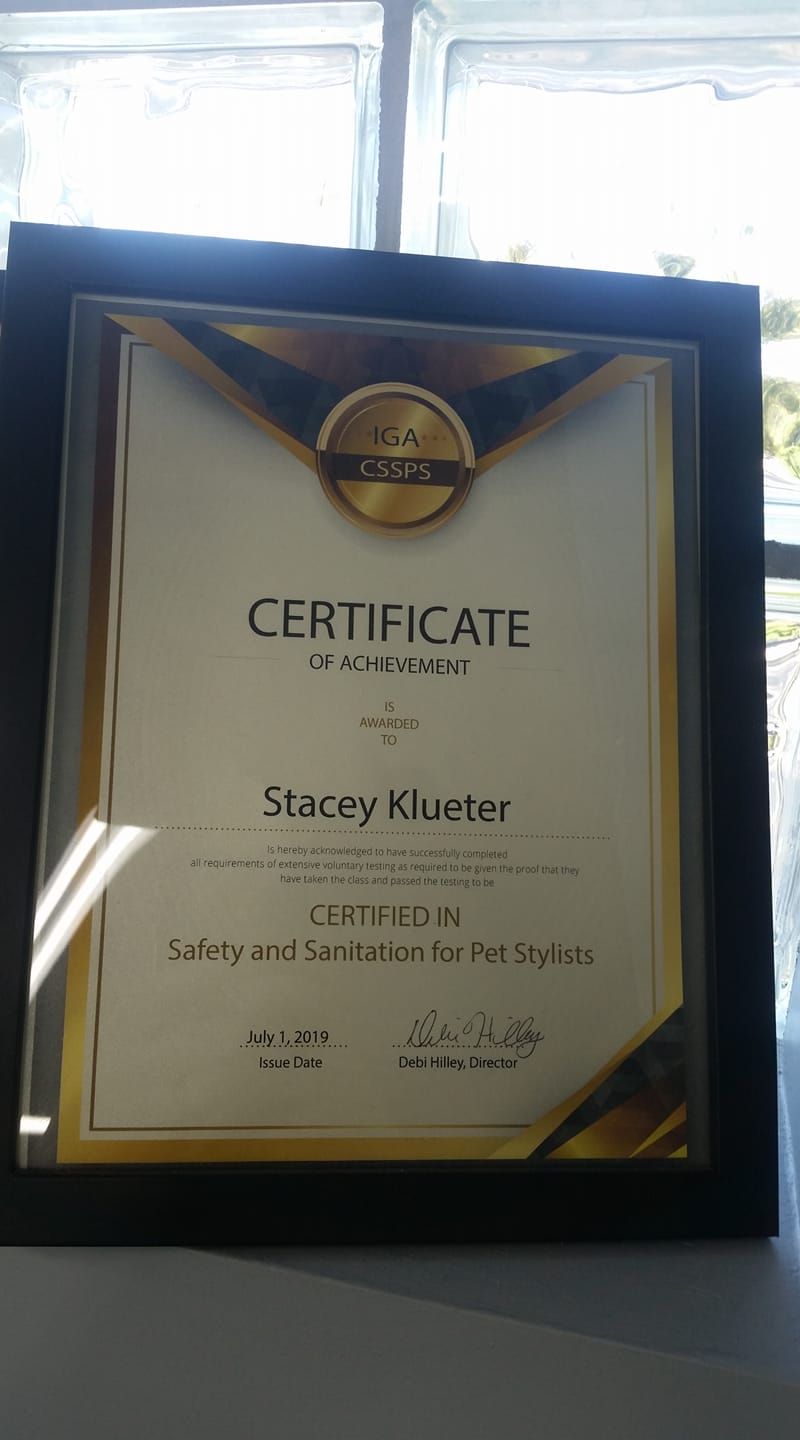
Safety and Sanitation Certified Groomers: What Does That Mean?

You have probably noticed us mentioning Safety and Sanitation Certification on this page before. It is something we take great pride in and something that definitely sets us apart from the rest! But what is it? What does it mean for your pets?

Our Safety and Sanitation Certifications through the Intellectual Groomers Association means that we have completed a fairly intense course on the subject and we have passed a knowledge quiz. The course covers nearly all aspects of cleaning, disinfecting, and sanitizing necessary to keep the salon environment as healthy as it can possibly be. We learned not only about various products which are human and pet safe to clean and sanitize, but also what daily, weekly, and monthly protocols we should have in place. We also learned about various aspects of tub, table, and emergency safety.

One of the very last things we would ever want to happen is a happy, healthy dog coming into our salon and then hearing two or three days later that they had to go to the veterinarian with an infection they likely picked up from us. It is so easy for things like fungal, bacterial, and viral infections to be spread through a busy shop completely by accident. No groomer would ever intend for a dog to become ill but we might not know that another client is! It only takes a moment of inattention for something like a fungal foot infection to be spread from one dog to another because a crate or table wasn’t cleaned and disinfected properly. Therefore, we have taken our new knowledge to heart and follow it to the letter!

Between every single pet, there is a lot of cleaning going on! The shammy towels we use as a first towel on your pet is placed in a vinegar solution which kills most of the common skin bacteria and fungus a pet might have. The wet towels we use on your pet are placed in the laundry bin. We NEVER reuse a wet towel on another pet. Period. A damp towel might be used to mop up water on the floor, but never on another pet. Yes, we do a lot of laundry all in the name of being sanitary! After your pup has been in our tub, not only do we rinse down and wipe out the hair, we also squeegee the water off the walls then spray them down with a peroxide based disinfectant. This is allowed to sit on the tub and walls until the next pet is brought over for a bath. Even though the cleaner is safe for pets and people, we still rinse the tub down before placing your pet in it. We do the same for the safety loops, the drying table, and even the dryer hose. Everything is cleaned and then disinfected before being used on the next pet. After your pet is done on our grooming tables, a similar process takes place. The removable table covers are vacuumed and placed in the laundry. The table top, even though it was covered the entire time, is sprayed down with the same peroxide based disinfectant. The grooming loops are sprayed and moved to the laundry bin. A fresh table cover is placed on the table top. A fresh loop is hooked up. Every tool that touched your pet is cleaned and disinfected before it is used on the next pet either with spray, heat, UV light, or ozone depending on the tool.

Have you noticed the cart between our grooming stations? That cart holds two of the most important disinfecting tools we have! We have a small heat sterilizer which we use for our shears. Any hair or dirt is wiped from the shears. They are then placed in the unit which contains small, heated glass beads. The high heat the beads are exposed to is then evenly transferred around the metal of our shears, killing any pathogens that might remain on them. The microwave-looking box is a sterilizer unit. This uses both UV light and ozone to sanitize tools which either cannot be exposed to high heat or that do not fit into the heat sterilizer. Clipper blades and attachments, combs, brushes, and other tools are placed in this box for 20 to 30 minutes. The combination of UV light and ozone destroys any and all pathogens, making the tools safe and sanitary for the next pet in line.

Once your pets are all gone for the day and the shop is ready to close, the more aggressive cleaners are brought out. These are excellent at cleaning and disinfecting, they are 100% safe to use in the presence of animals, but due to their nature, we feel it is safer to wait until everyone is gone to eliminate the potential risk of irritating someone with a sensitive throat or lungs. Best Shot 256 is used to wipe down all the kennels used during the day, even if we cleaned them with the peroxide based cleaners after a pet checked out and it was not used again. The tub and tables can be sprayed down as well. We will even wash down the walls and baseboards with Mrs. Meyers cleaners on a regular schedule to be sure there are no sneaky pathogens hanging out there, waiting for something to touch them and transfer to a tub, table, or towel! The floor is swept, vacuumed, scrubbed, and mopped with Best Shot, ensuring there is as little hair and dirt on it as possible. Twice a week, we even set up an ozone machine which helps to sanitize the air in the building, reducing the possibility of airborne pathogens and even mold and mildew. In the future, we hope to install a UV/Ozone sanitizer in our heating/AC system to further aid in our quest to be as sanitary as humanly possible.

While sanitation was the main focus of the course, safety was a big part as well. While we already knew the basics of never walking away from a dog on the table or in the tub, it covered other aspects of safety we might not think about, such as having a plan in case of a dog escaping, an aggressive intruder, or even a fire. We do have plans in place for each scenario! Of course, prevention is the best way to approach each of these.

There are times you might show up for your appointment only to find the door locked. You can’t get in! Don’t worry! There is a doorbell. Why is the door locked even though we knew you were coming? If we are working alone, keeping the doors locked is the safety option for us and your pets! If a pet manages to get out of their crate, off the table, our out of our control, the gate is our first line of defense. They can’t get to the door. However, an athletic or determined dog can potentially clear that gate! By having the door locked, we can assure that an unsuspecting owner coming for an appointment doesn’t accidentally open the door while we are trying to coral the Houdini, thus allowing the escapee access to the outside world. While we are in a small, safe neighborhood, we also have to worry about the possibility of an intruder coming into the salon as well. By keeping the door locked when we are not expecting anyone, and when we are alone in the salon, we can keep an aggressive intruder at bay long enough to call the police for help, thus keeping ourselves and your pets safe and sound!

We are confident our little salon will be safe from all but the most aggressive of storms given that it is made from solid brickwork. However, fire is still something that we have to worry about. While our fire risk is low, it is always a possibility. Rest assured that we have a plan in case of fire that does include getting your pets out quickly and safely! If there is ever a fire in the building, all pets will be evacuated through the nearest exit. They will go into our cars as quickly as possible. Our cars will then be moved far enough away from the threat to be safe but not so far that you will have a hard time finding us. Owners would be notified as soon as possible of the incident so they can come collect their pets.

If you ever have any specific questions about our safety or sanitation protocols, please ask us! If you are concerned about any product we use, we will be happy to show you what we use and how we use it. If your pet has any allergies or sensitivities, please let us know so we can adjust for their well being! While we never use products in close proximity to your pets, we do understand that they might be sensitive to products being used in the same room. So ask away! Let us know! We’re happy to adjust to accommodate your furry friends! 

(P.S. - Jess recently passed her class as well!  We are waiting for her certificate to arrive in the mail so we can hang it on the wall with Stacey's for everyone to see!)

Wednesday, January 22, 2020

Humanity Before Vanity

“Humanity before vanity.” You have heard us say it. We 

tag it on Instagram. It is our profile picture on Facebook. But what 

does it mean?

Humanity before vanity means we will never harm a pet to please a

 human.

Humanity before vanity means we will never push a pet beyond

 their limits for the sake of looks.

Humanity before vanity means we will never compromise a pet’s

 health or happiness to achieve “perfection.”

Humanity before vanity means the welfare of the pet always comes

 before the wants and desires of their human owners. Period.

At TLC Pet Services, everything we do is for the welfare of your 

pets. We take a hard stance on issues such as dematting, timing, and

 perfection.

By definition, dematting is the removal of tangled or matted coat 

from a pet. Generally speaking, when most groomers talk about 

dematting, they are referring to the process of brushing an 

extensively matted coat. Many owners do not want their dogs 

shaved short. They want all those tangles brushed out. A little 

conditioner should loosen it all up, right? And the dog won’t care, 

because they are just a dog! Wrong.


Dematting a coat can cause both physical and psychological 

damage to a pet. Tight matts can literally take hours to brush out. 

Even with the utmost care, it is likely the dog will end up with at 

least a few spots of brush burn, an irritation caused by the brush 

scraping one spot on the skin too many times. Tight matts can hide 

problems such as bruising, wounds, and infections. The matts are 

painful enough. Brushing over them can cause even more pain! 

There is a high chance any infections can become worse and could 

spread. A dog who is subjected to this process for the sake of 

vanity is likely to start dreading their grooming sessions. They may 

start to become fearful of the process or aggressive as they now 

anticipate grooming with pain. Imagine having a huge snarl in your

 own hair. The hairdresser refuses to shave it out and instead forces 

you to spend an hour sitting in the chair, scolding you if you 

wiggle, while pulling at your scalp. Is the pulling intentional? No. 

But it will happen no matter what products are used. You would not

be very happy and you would not want to go back to that 

hairdresser again!


Apart from the potential damage to the skin, dematting also 

damages the dog’s coat. When the hair matts together, the 

microscopic scales on each hair is acting like velcro. They stick 

together tightly. Brushing rips these scales apart as the hairs are 

separated, causing them to further fray. Often the dematted coat 

will have a frizzy appearance due to the damage. No amount of 

conditioner will repair all of the damage. Even with extra products 

and attention, the previously matted hair will matt again. The new 

matts usually form faster and will likely be tighter than before.


The only safe and comfortable way to dematt a coat, and the only 

way TLC Pet Services will dematt a coat, is by using clippers to 

shave as close as necessary to get between the matting and the skin.

 While we may attempt to brush a small spot here and there IF the 

dog tolerates it, we will not dematt the entire pet in any other 

manner.


Many folks want their pets back in their homes as soon as possible. 

We absolutely understand that! However, another aspect of 

humanity before vanity is timing. In a society that is all rush, rush, 

rush, we sometimes forget that going slow can be better for 

everyone. Some pets can be groomed in an hour or two. Some pets 

respond better to a slower approach and appreciate breaks. These 

pets might take three hours or more. Could these pets be groomed 

faster? Sure. Will they cooperate, be happy, and keep their positive 

attitudes about grooming? Not likely. Since we want everyone to be

 happy, safe, and comfortable, if a pet requires extra breaks, the pet 

will get extra breaks.


Perfection is a big part of why we believe in humanity before 

vanity. We all want our dogs to strut out of the grooming salon 

looking show ready! We want them to sparkle. We want every 

single hair in place. We want them to be the very picture of 

perfection! But sometimes what we want and what the pet can 

handle are two different things. Young puppies, seniors, and cats 

quite often get what we refer to as a “comfort groom.” There are 

times where we sigh and say “Well. Close enough is good enough I 

guess.” Why? Because the pet just isn’t having it! Believe us, we 

want your dog to strut out looking exactly like you pictured and we 

want your cats to be fluffy perfection! Sometimes, it just isn’t 

possible. The grooming process can be scary for inexperienced 

youngsters and for seniors who are either going blind, deaf, or 

maybe a little senile. Rather than force them into a perfect groom, it

 is better for them psychologically to just do the best we can. A 

young pup is being taught that grooming is not scary. A senior 

needs to be handled with care as they might be starting to 

experience some arthritis pain during the process. Cats are...cats.

 You never know what even the most perfect cat is going to do from

 one grooming session to the next!


For these pets, and for any nervous or fearful pets, we will always 

take the comfort approach. If they have any matting, the matts will 

be removed first. The sani trim will be done. We will do our very 

best to complete the haircut to the owners specifications but if the 

pet can’t handle it, we will not force it. Again, we want grooming to

 be fun and safe, not scary!


We understand that not everyone agrees with our approach. We will

 make every effort to work with you and your pets however, we 

will always chose humanity over vanity!

Wednesday, January 15, 2020

What sets us apart from everyone else? "Small Spaces"


Our next series of topics will deal with what makes us special. 

Things that help to set us apart from the rest!


One of the biggest things that sets us apart from some other salons, 

especially from big box corporate stores, is our size! If you have 

been into the building, you know that TLC Pet Services is small! 

When you walk in, what you see is pretty much all there is! We 

have a small area behind the wall that is about half the size of the 

grooming room where we have our tub, drying table, kennels, and 

furnace. We can comfortably keep 7 dogs in our kennels. With a 

little wiggling and setting up crates and x-pens in the grooming 

room, we can house a few more. Since there are only two of us 

here, odds are there will be no more than 6 dogs in the building at 

any given time (not including Lucky the shop dog of course!) 

Some of the larger corporate salons have literally dozens of 

kennels. 30+ is not unheard of in the larger stores. With a half 

dozen groomers and several more bathers, all these kennels can be 

filled all day long with dogs.


Sometimes, bigger is not always better. Many dogs become 

overwhelmed in such a large, noisy, slightly crowded environment. 

Who could blame them? The dryers are running. The bathers are 

bathing. Dogs around them are barking. Clippers are going. People 

are talking. Customers and coming and going. Other customers are 

watching through the windows. It can be very overwhelming! 

Nervous dogs then either shut down and just accept what it 

happening or they start to fight back out of fear. Some dogs might 

not like other dogs but they feel like they have no room to escape. 

They start barking in fear or frustration because they can see four 

other dogs and hear a dozen more. Even a good, well mannered 

dog who is used to the grooming process might start barking along 

if others are. My own Shaak Ti was well known for starting “sing 

alongs!” She would howl in her kennel and get all the other dogs 

barking and howling along!


TLC Pet Services is small. Very small. Purposefully small. Would 

we like a bit more room? Yes but what we have is pretty much 

perfect. By staying small, we can control who comes on what day. 

We can control the level of noise in the building. We can book 

nervous dogs on one day and the barkers on another. Does your 

dog do best when there are no other dogs around? No problem. We 

can book you first thing in the morning on a quieter day, last thing 

in the afternoon after the rest of the dogs have left, or even a day 

when we know we have a full house with only well mannered, 

quiet, non-threatening dogs. Maybe your dog doesn’t like other 

dogs but is great with cats. We will eventually have cat only days. 

Your dog might be a candidate for coming toward the end of a cat 

only day. We even have the ability to open on a special day just for 

a special dog if we really need to. Each day is tailored to the dogs 

and cats on the books.


Both Stacey and I came from a corporate back ground. While we 

are not here to bash corporate salons or their groomers (we’re all 

on the same team after all!), we did absolutely have some problems

 with the way things were done which influenced why TLC is TLC.

 The biggest thing we wanted to change beyond creating a quieter 

environment was eliminating walk-in services. Walk-in nail trims, 

brush outs, teeth brushing, and even nail painting seems like a 

convenient thing, right? It absolutely is! However, it can cause 

added and unnecessary stress to the dogs who have appointments. 

When a walk-in client walks in, the groomer or bather must put the 

dog they are working on back in a kennel while they assist the 

walk-in. After they have trimmed the nails, brushed the dog out, 

etc, they then get their appointment dog back out and continue their

 scheduled service. One or two breaks probably won’t make a big 

difference to that appointment dog’s attitude about the day. But 

once you hit three, four, ten or more breaks, that dog starts to feel 

just as frustrated as the groomer does! We don’t want that 

happening to our clients. That is why we decided that even nail 

trims need to be scheduled. It is all for the comfort of the pets in 

our care!


With up to a dozen or more people working in a larger salon, 

corporate or not, it can also be hard to know who is doing what on 

any given day. While this might not make a big difference in some 

areas like folding towels or sweeping the floor, when it comes to 

cleaning, it can be a big problem if things are not properly 

organized and tasks are not properly assigned! By being a small 

salon, we know exactly who is cleaning what on any given day. We 

have a schedule for cleaning, disinfecting, and sanitizing that we 

follow between each dog and at the end of the day. There are daily, 

weekly, and monthly tasks that we undertake so we know things are

 clean, tidy, and most importantly sanitary for your pets! With only 

two people, it doesn’t take long to figure out who washed the 

windows yesterday or when the floor was last mopped! We know 

with absolute certainty that the tub has been disinfected between 

dogs. We know 100% that the floor has been swept, vacuumed, and

 mopped. We’ll cover our policies and procedures for cleaning in 

more depth in the future too.


Most importantly, our small size lets you be confident that your 

dogs and cats know their groomers! Even if Stacey is their regular 

groomer, they will be familiar with Jess as well since she is the 

only other person in the building most of the time. Stacey will 

know if Jess’s regular clients have any little quirks such as needing 

to be in a bottom kennel or needing to “fly” for their nails. Regular 

clients will be familiar with both of us and can be confident when 

leaving their dogs in Jess’s care because Stacey is running a few 

minutes late. Personable and personal service are our goal! We 

never want to have a staff so large that you don’t recognize all the 

employees floating around!


We value the comfort, health, safety, and happiness of our furry 

clients and their parents! We want everyone to be comfortable in 

our purposefully small space!

Feline and Canine Body Language

The process of grooming a dog is so much more involved than many people realize. Not only are we bathing, drying, cutting hair, and...